Real-time perioperative performance improvement

Operating Room Efficiency Software for Hospitals and Surgery Centers

Synchrony communicates expectations and measures every interval in real time and displays performance providing the information necessary to achieve optimum Operating Room Efficiency. This results in improvements in surgeon and staff satisfaction and hospital/ASC economics.
Case Study
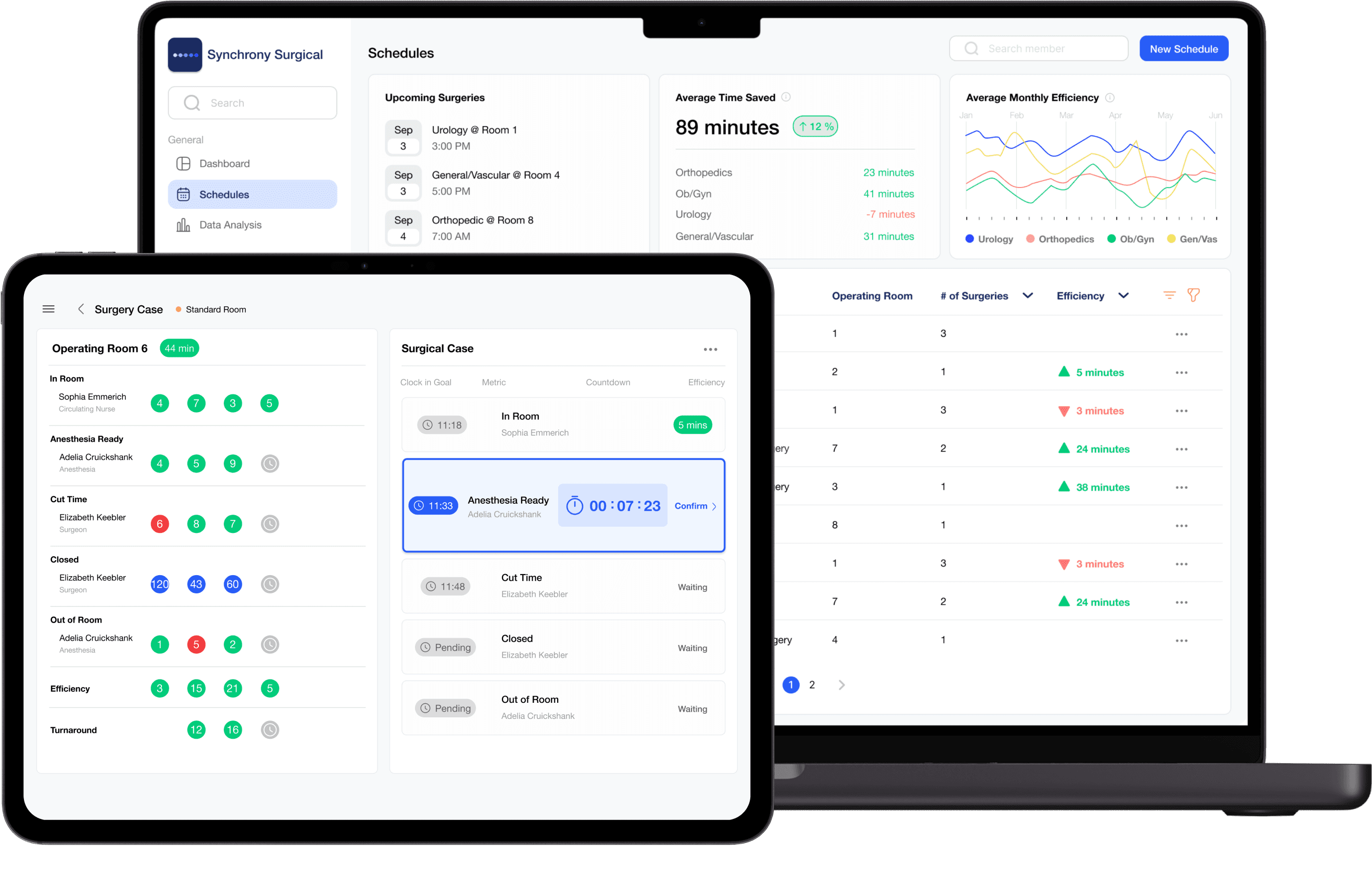
The Synchrony Surgical schedules dashboard shown on a laptop and a tablet

Average Time Saved

89min / room / day

Saving of $4,183 / room / day

Surgical cases follow a predictable sequence from check-in to discharge — each providing a valuable opportunity for time savings.

Most operating rooms state their expectations loosely, measure a few of those intervals, and learn how the day actually went once it is over.

Synchrony communicates an expectation on every interval, measures each one in real time, and assigns it to the surgical role that owns it — so performance is visible while the day is still running and the analytics assemble themselves. Your team holds to its expectations, moves more cases through the day, keeps surgeons and staff happier, and spends less per case.

Operating Room5 intervals
  1. In Room
  2. Anesthesia Ready
  3. Cut
  4. Closed
  5. Out of Room
180OR intervals, 6 rooms x 6 cases
30turnarounds between them
210surgical metrics to manage in a day

Every case runs the same in-room sequence, and every room runs case after case. Five intervals per case turns into a hundred and eighty across a day, and the turnarounds between those cases add thirty more. Someone has to notice, time, and own each one.

No clipboard, spreadsheet, or end-of-month report keeps up with that. Synchrony Surgical measures all of it, in every room, while the day is happening.

Start with the problem you have

Pre-Op nurseReady
Anesthesia sign-inReady
Surgeon sign-in4 min late

Sign-in and First Case on-time Start

Track first-case readiness from Pre-Op nurse to anesthesia and surgeon sign-in, so the day starts on schedule.

Learn more about Sign-in and First Case on-time Start

Cost Impact · this month

+1,842min saved

$86,574at $47 / OR minute

Operating room efficiency

See how efficiently each case flows, and what the minutes saved or lost are worth across the whole OR schedule.

Learn more about Operating room efficiency
Before47 min
Measured against expectations20 min

Turnaround time

Measure the minutes between one patient leaving the room and the next coming in. Most systems never capture and post it visibly in real-time.

Learn more about Turnaround time
See where the day loses time

What makes the improvement stick

Define what each interval should take, display it while the room is still running, and analyse what changed. The third step feeds the first: when a target turns out to be wrong, you correct it and measure against the new one, so the gains outlast whoever championed them.

Three operating rooms side by side on the dashboard, each showing every role against its expectation and a recorded time for every interval as the day runs
Three rooms at once, every role against its expectation, while the day is still running.
Define

Set the expectation once

Every interval gets a time it should take and a surgical role that owns it. Both can differ by department and case type.

Display

Everyone reads the same clock

One tap on the tablet in the room updates the dashboard and the in-OR display together, while there is still time to change it.

Analysis

What the cases add up to

Once enough cases accumulate, you can slice performance by role, individual, department and period. Every figure converts to dollars.

See operating room efficiency measured in real time

The EMR question

Yes, your EMR records the times

Most teams who see this say they already have it, and they have part of it. Every EMR writes down when the patient came into the room and when they left, turnaround included. That is real, and it is worth conceding before anyone checks.

What it does not do is measure those times against what they were supposed to be, attribute them to the role that owned them, or put any of it in front of the team while the room is still running. Of the fifteen things a surgical team needs in order to manage a day, an EMR covers four. The other eleven are the ones that change what happens next.

See all fifteen, and which four your EMR covers

Proof

47 → 20

minutes of turnover

Defining and measuring interval expectations cut turnover from 47 to 20 minutes at Spine & Joint Institute. They did it manually. Synchrony is how you do it across every room without a spreadsheet and a champion.

How they did it

One platform for surgical case flow

See how teams define their intervals, record each one with a single tap in the room, and watch performance as the day happens.

Explore the platform

Request a Demo

Book a 30 minute live, interactive demo and we’ll show you how Synchrony Surgical helps your OR team run more efficiently and cut delays.

Try our 60-Day Assessment

We’ll only use these details to respond to your request. Read our Privacy Policy.

The Synchrony Surgical dashboard on a laptop, tracking two operating rooms against their expectations